Rangitoto College is proud to be a dual‑pathway school, offering both NCEA and the globally recognised International Baccalaureate (IB) Diploma Programme.
Our inspiring programmes extend and challenge students to develop the skills and expertise needed to become inquiring, knowledgeable, confident, and caring young people. High levels of academic success are achieved through a balance of challenge and support.
We select only the best specialist teachers from New Zealand and overseas. Their creativity and expertise are continually enhanced through extensive professional development and leadership opportunities, drawing on both local and international best practice.
Gifted and Talented Education (GATE) Our extensive GATE programme provides enrichment, extension, and accelerated study for the most able students. Every subject offers pathways to meet the needs of individual learners.
Learning Support A dedicated Learning Centre ensures that students who need extra assistance receive personalised programmes, helping every learner reach their full potential.
The Rangitoto College Year 11 Diploma has replaced the traditional Level 1 NCEA qualification. This programme offers students the opportunity to engage in a rigorous, knowledge-rich curriculum designed by subject experts at the college. Students will be able to attain the Year 11 Diploma with white, red, or blue endorsement, reflecting their level of achievement.
The Year 11 Diploma is a holistic qualification that incorporates:
- Academic performance
- Extra-curricular involvement
- Service leadership
- Attendance
- Academic engagement
Year 11 students sit one set of exams in November, aligned with the NZQA and NCEA examination schedule.
In 2025, the Year 11 Diploma pass rate was 71%, highlighting the importance of students ensuring that they are on track for meeting all of the criteria within the diploma. For those students who narrowly missed out, many could have gained this through greater participation in school-based extracurricular activities or by meeting the attendance requirements.
NCEA (National Certificate of Educational Achievement) is a flexible, internationally recognised qualification. It comprises both internal assessments—conducted within the school and underpinned by our world-class teaching—and external assessments, such as end-of-year examinations and portfolio submissions.
Throughout the year, students are assessed using a variety of methods, including assignments, practical tasks, presentations, and project work. At Rangitoto College, students follow the NCEA curriculum in Years 12 and 13.
All students enrolled for a full academic year (February to December) are required to sit NCEA exams at the end of the year. For our international students, NCEA fees are included in the tuition and are managed by the school.
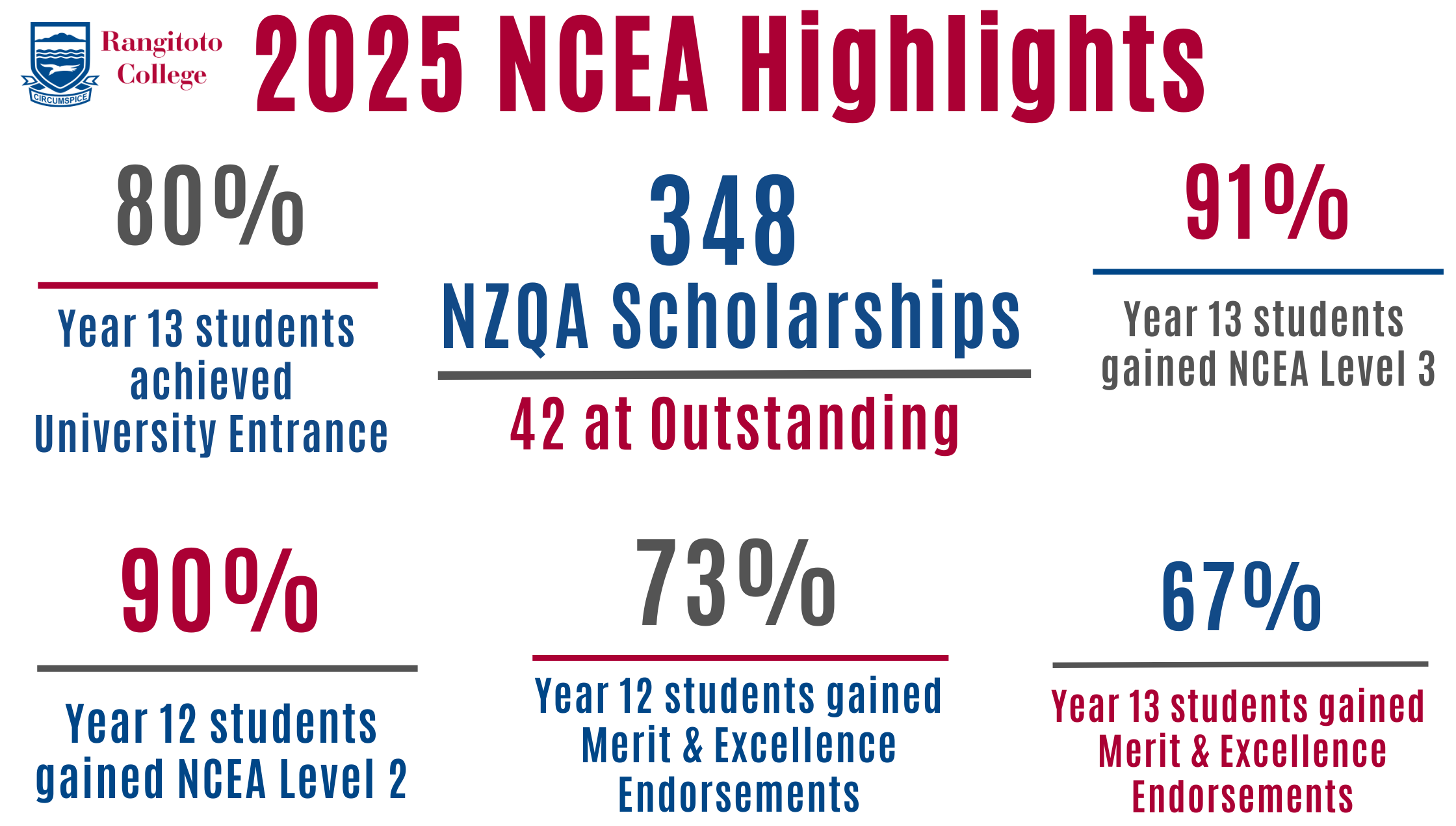
We are proud to report the continued high levels of academic achievement by Rangitoto College students. Our strong NCEA results reflect the exceptional performance of our learners, consistently placing us ahead of comparable schools. These outcomes affirm Rangitoto College’s position as one of New Zealand’s leading academic institutions.
Our NCEA pass rates for Levels 2 and 3 have once again exceeded 90%. We are particularly pleased to see a significant lift in high-level achievement; Year 12 Excellence endorsements rose by 3%, bringing the total to 38% for this year group. Combined Merit and Excellence rates also climbed, underscoring the success of our Year 11 Diploma. Having replaced NCEA Level 1 in 2024, this Diploma is already proving its value by providing a superior foundation for senior academic success.
Our Year 13 students also performed strongly, achieving 30% Excellence Endorsements. Furthermore, our University Entrance (UE) rate remains exceptionally high at 80%—a figure that stands in proud contrast to the national average of 49.9%.
Across the board, Rangitoto College continues to outperform both national benchmarks and schools within our socio-economic equity band. This consistently high performance highlights the strength of our teaching and the unwavering dedication of our students.
Students undertaking the IB Diploma graduate with the skills to excel at universities worldwide. Over two years, they study six subjects and complete the CORE: Theory of Knowledge, a university‑style Extended Essay, and CAS (Creativity, Activity, Service). Many also achieve the prestigious Bilingual Diploma, highly regarded across the academic world.
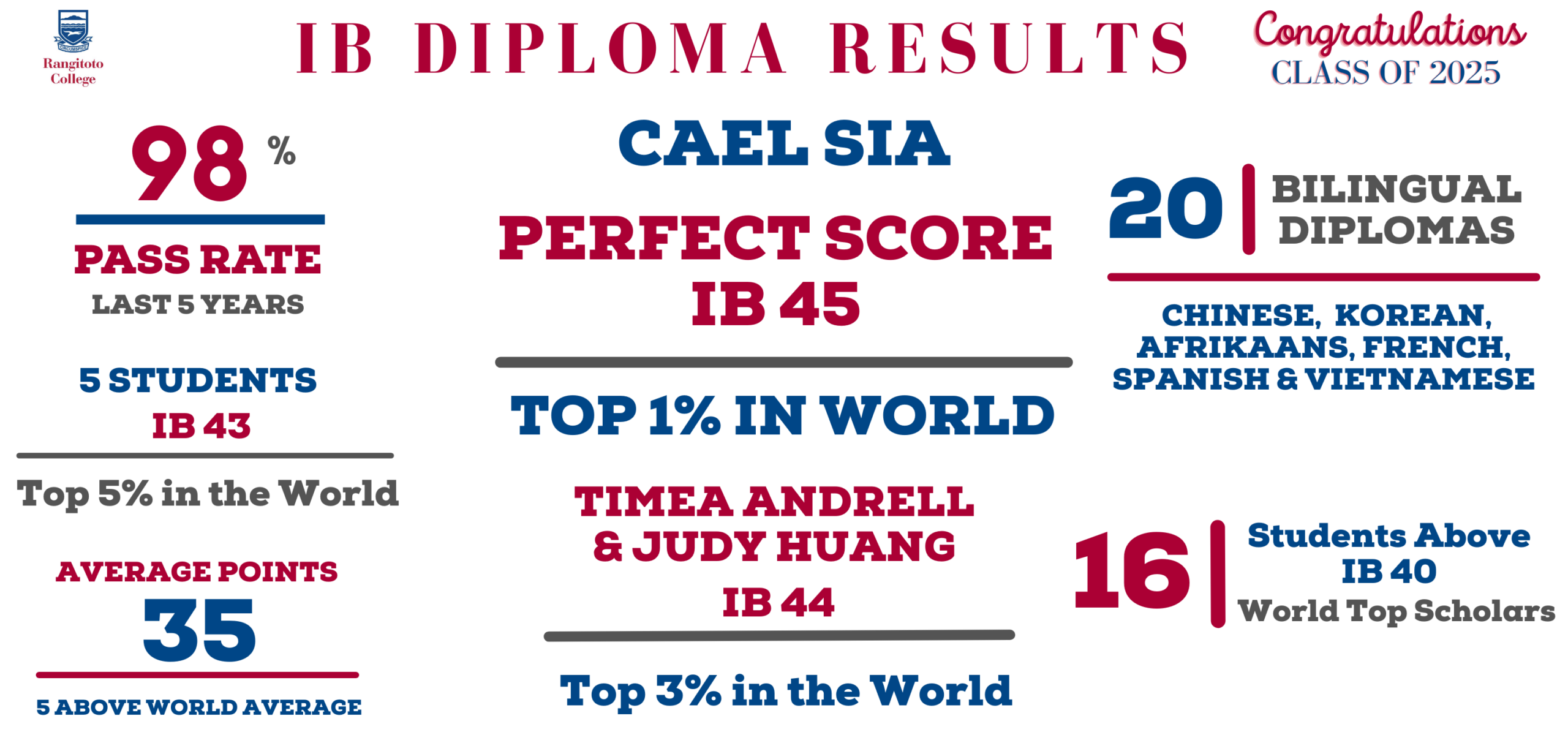
The International Baccalaureate (IB) Class of 2025 at Rangitoto College has once again delivered an exceptional year of results. Highlights include:
-
Elite Global Performance: Guo (Cael) Sia achieved a perfect score of IB 45 placing him in the top 1% of students in the world.
-
Timea Andrell and Chuqiao (Judy) Huang achieved a phenomenal IB 44 (out of a possible IB 45), placing them in the top 3% of students globally.
-
Top 5% Worldwide: Five students earned an impressive IB 43, Youran (Yolanda) Zhang, Katie Huang, Joshua Lo, Hanlu (Annie) Wang, and Daniel Wei.
-
High Honours: 16 students above IB 40, who are World Top Scholars.
-
Global Fluency: 26% of our graduating class earned the prestigious IB Bilingual Diploma. This year, 20 students achieved this distinction across different language pairings—including Chinese, Korean, Afrikaans, French, Spanish and Vietnamese. This reflects a deep dedication to literary excellence in both English and a second language.
Academic Leadership: Rangitoto College’s school average of 35 points continues to significantly exceed the global average of 30.5. Our growing IB enrolment has allowed for greater subject flexibility and a wider pool of highly qualified IB educators, reflecting the commitment to excellence shared by our students and teaching staff.
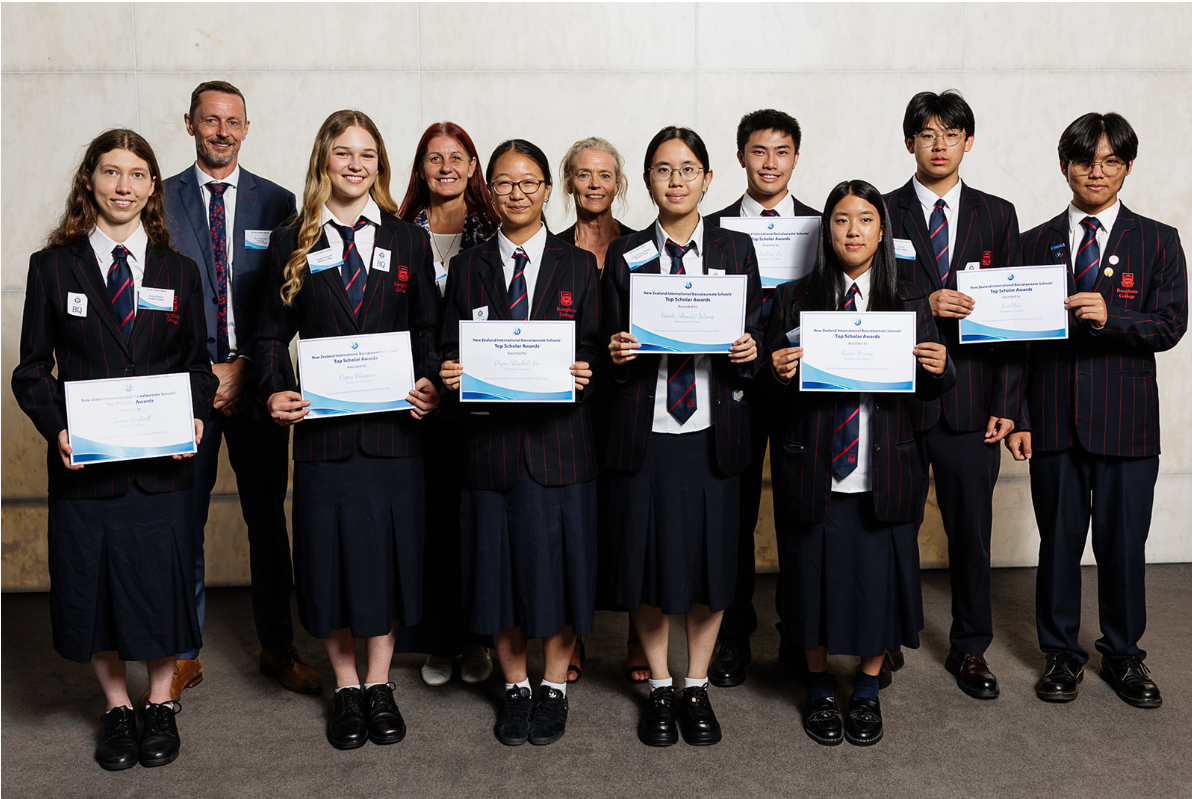
Our Top Scholars of our 2025 International Baccalaureate joined the Minister of Finance in Wellington to celebrate their distinguished accomplishment in scoring above 40 in their IB exams. Rangitoto had an incredible number of 17 students who qualified for this honour: Guo (Cael Sia), Timea Andrell, Youran (Yolanda) Zhang. Katie Huang, Joshua Lo, Hanlu (Annie) Wang, Daniel Wei, Chuqiao (Judy) Huang, Zhaoyuan (Alvin) Li, Mary Haddad, Di (Judy) Hu, Davin Chen, Banghan (Edward) Xiao, Leo Wang, Poppy Glasgow, Diqiu (Rachel) Gu and Enoch Mun.
Congratulations to these wonderful alumni of Rangitoto. We wish you all the best with your future endeavours.
Global Pathways
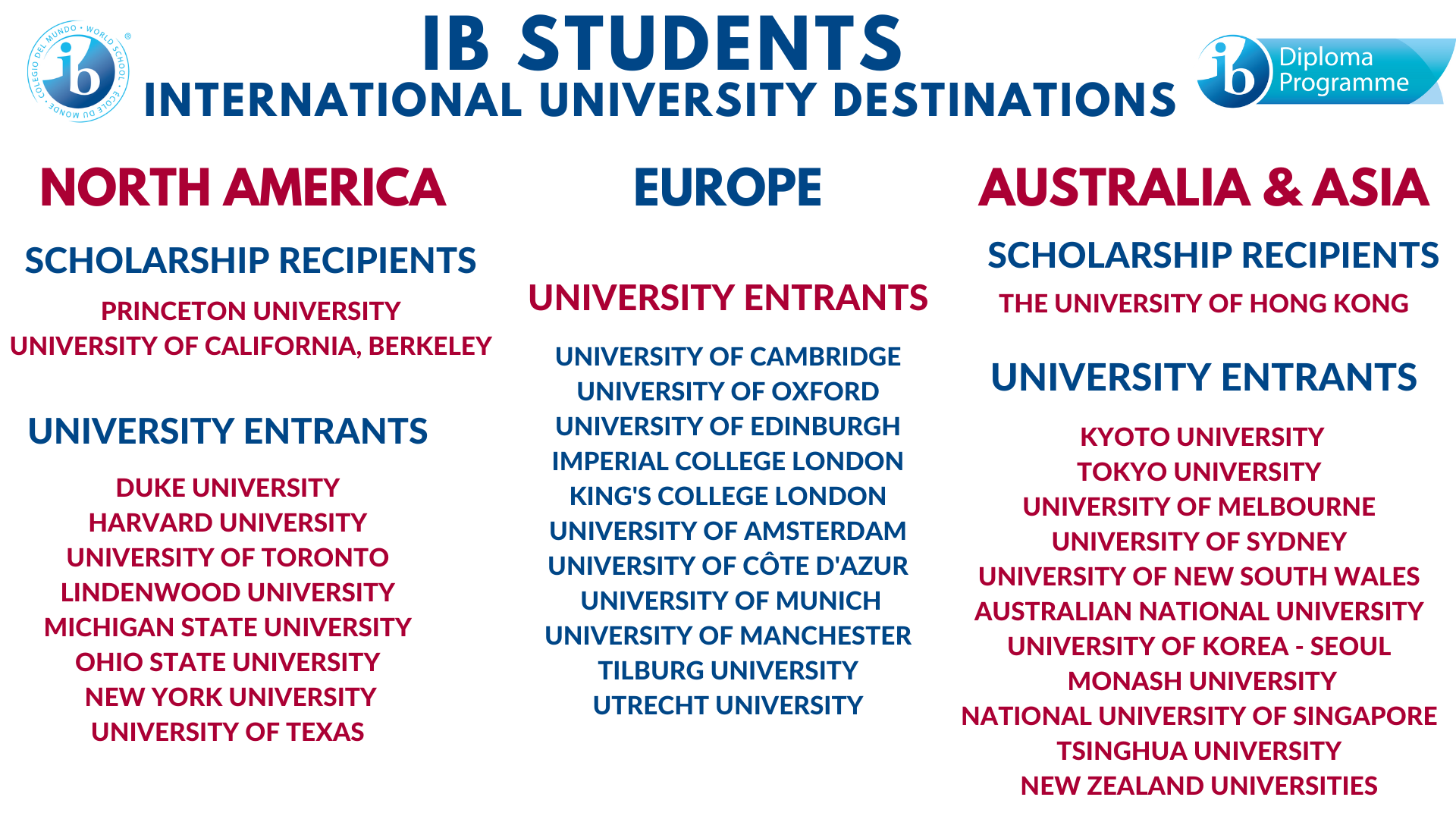
Our graduates continue to secure admission to the world’s most prestigious institutions. Rangitoto College is proud to celebrate the growing number of IB students awarded full scholarships to elite international universities. While many of our graduates choose to pursue their studies overseas, others accept offers from New Zealand universities such as University of Auckland, University of Otago, and other leading local institutions.




 BACK
BACK